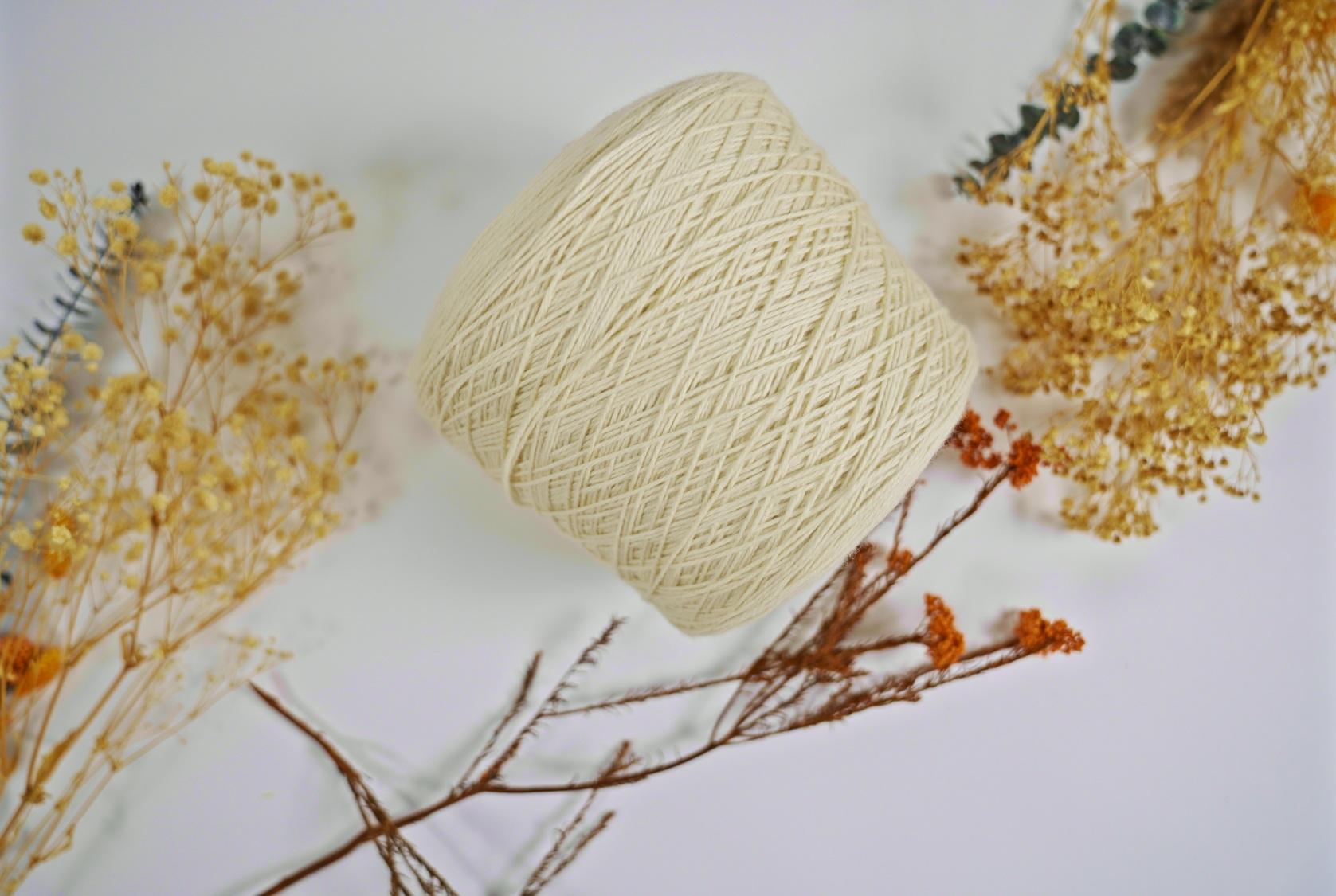
How to Work With Deadstock Cone Yarn
The Complete Guide to Reading Labels, Understanding NM Counts & Washing Out Spinning Oils
If you've already discovered the incredible world of deadstock yarn, you've probably experienced the same moment every knitter does.
Your beautiful cone of Italian cashmere, merino, silk, or alpaca arrives in the mail. You unwrap it, admire the luxurious fiber, flip over the label…
…and immediately wonder what on earth 2/6000, WS, NM, and a string of industrial codes are supposed to mean.
Unlike yarn purchased from your local yarn shop, industrial cone yarn isn't packaged for hand knitters. There are no helpful icons telling you the recommended needle size, yarn weight, or metres per 100 grams. Instead, you're looking at information intended for textile manufacturers and knitting mills.
The good news?
Once you understand how to read industrial yarn labels, you'll unlock an entirely new level of confidence when shopping for deadstock yarn. You'll be able to estimate yarn weight, compare different cones, understand fiber compositions, and choose the right yarn for your next project without relying on guesswork.
In this guide, you'll learn exactly how to work with deadstock cone yarn from the moment it arrives on your doorstep until the moment you wash your finished garment and watch it bloom into its full potential.
We'll cover:
- How to read industrial cone yarn labels
- What NM yarn counts actually mean
- How to calculate metres per 100 grams
- Common fiber abbreviations used by Italian spinning mills
- Why cone yarn often feels stiff when it arrives
- How to remove spinning oils safely
- Why washing transforms the look and feel of luxury yarn
If you're new to deadstock yarn, we recommend reading our Beginner's Guide to Deadstock Yarn first to learn where cone yarn comes from and why it's become one of the best-kept secrets among knitters. Once you've done that, this guide will teach you how to confidently work with every cone you buy.
Why Deadstock Yarn Comes on Cones Instead of Skeins
One of the first things that surprises knitters is that deadstock yarn almost always arrives on a cone rather than in a skein.
If you've spent years knitting with yarn from local yarn shops, cones can seem unusual. They feel more industrial, less familiar, and often much larger than a standard skein.
There's a simple reason for that.
Deadstock yarn wasn't originally produced for hand knitters—it was made for industrial knitting machines.
Luxury fashion houses and textile manufacturers knit garments on high-speed industrial machines that require thousands of metres of uninterrupted yarn. A cone allows the yarn to feed continuously without frequent joins, making production faster and more efficient.
For hand knitters, this actually offers several advantages.
The Benefits of Cone Yarn
Once you become comfortable working with cone yarn, you may find it difficult to go back to skeins.
Cone yarn offers several practical benefits:
- Fewer joins. Large cones often contain enough yardage for an entire sweater, reducing the number of ends you'll need to weave in.
- Consistent dye lots. Buying a full cone helps ensure your entire project comes from the same production batch.
- Less waste. Because cone yarn feeds continuously, there's less leftover yarn trapped in partially used skeins.
- Excellent value. Deadstock cone yarn often costs significantly less per gram than comparable retail skeins, especially when working with luxury fibers like cashmere or silk.
The only difference is that you'll need to learn how to interpret industrial labels instead of relying on retail packaging.
Fortunately, that's much easier than it looks.
How to Read Cone Yarn Labels
Industrial yarn labels may look intimidating at first, but they follow a logical structure.
Most labels include the same core pieces of information:
- Manufacturer or spinning mill
- Yarn name
- NM yarn count
- Fiber composition
- Colour
- Dye lot or production information
Once you understand each section individually, you'll be able to decode almost any cone you come across.
Let's break them down one by one.
1. The Mill or Manufacturer
At the top of most cone labels, you'll find the name of the spinning mill or yarn collection.
Examples include well-known Italian mills and luxury manufacturers whose yarns are used by premium fashion brands.
This information tells you where the yarn originated, but it doesn't affect how you'll knit with it.
Instead, think of it as the yarn's manufacturer—similar to seeing the brand name on a retail skein.
2. The Yarn Name
Below the manufacturer, you'll often see the commercial name of the yarn itself.
For example:
- Royal Collection Tweed
- Twist Course 311
- Harmony
- Soft Cash
- Royal Alpaca
These names help distinguish one yarn base from another but don't tell you anything about thickness or fiber content.
The information knitters care about comes next.
3. The NM Yarn Count (The Most Important Part of the Label)
If there's one thing you learn from this guide, let it be this:
The NM yarn count tells you how thick the yarn is.
Every industrial cone includes an NM count, and understanding it means you'll never have to guess whether a cone is lace weight, fingering weight, sport weight, DK, or something else entirely.
It's the single most valuable skill you can learn when buying deadstock yarn.
A typical label might display:
2/6000
or
3/11
At first glance, those numbers seem cryptic.
In reality, they're simply describing how the yarn has been spun.
Before we dive into the calculations, it's important to understand one basic concept.
What Does the First Number Mean?
The number before the slash tells you how many plies make up the finished yarn.
For example:
1/ = single-ply yarn
2/ = two-ply yarn
3/ = three-ply yarn
4/ = four-ply yarn
This doesn't necessarily correspond to the British "4-ply" yarn category. Instead, it literally refers to the number of individual strands twisted together to create the finished yarn.
A two-ply yarn contains two fine strands twisted together.
A three-ply yarn contains three.
A four-ply yarn contains four.
The second number tells us how long each of those individual strands is.
What Does the Second Number Mean?
This is where many knitters become confused.
The second number refers to the length of each individual ply, not the finished yarn.
For example:
2/6000
means:
- two plies
- each ply measures 6,000 metres per kilogram
To calculate the finished yarn's yardage, divide the second number by the first.
6,000 ÷ 2 = 3,000 metres per kilogram
Since most knitters think in 100-gram quantities rather than kilograms, divide by ten again:
3,000 metres per kilogram = 300 metres per 100 grams
That immediately tells us this yarn falls roughly into the DK to sport weight range.
Once you understand this simple calculation, every industrial label becomes much easier to interpret.
Example: Decoding a Cashmere Blend
Let's look at a real-world example.
Imagine your cone label reads:
2/6000
76% WS
17% WO
7% SE
Here's what we now know.
The yarn is made from two plies.
Each ply measures 6,000 metres per kilogram.
The finished yarn therefore measures:
3,000 metres per kilogram
or
300 metres per 100 grams.
Looking at the fiber abbreviations, we can also identify the composition:
- 76% Cashmere
- 17% Wool
- 7% Silk
Without knitting a single stitch, you've already learned the approximate yarn weight, the number of plies, and the fiber blend simply by reading the label correctly.
That's incredibly valuable when you're shopping online, where you may not have the opportunity to handle the yarn in person.
Why Some Labels Look Different
Not every spinning mill prints NM counts in exactly the same way.
Sometimes you'll see:
3/11
instead of
3/11000
Don't panic—it's the same system.
Some manufacturers express the measurement in metres per gram, while others express it in metres per kilogram.
Both labels describe the same concept.
The only difference is the unit being used.
In the next section, we'll walk through several real examples—including 2/6000, 3/11, 2/14000, and 1/15000—so you'll be able to calculate the approximate yarn weight of almost any cone in just a few seconds.
Understanding NM Yarn Counts: The Complete Guide
If you've ever searched "What does 2/6000 mean on yarn?" or "How do you calculate NM yarn counts?", you're not alone. It's one of the biggest hurdles knitters face when transitioning from retail yarn to industrial cone yarn.
The good news is that once you understand the NM system, it becomes one of the most useful tools for choosing yarn online. Instead of relying on vague descriptions like "light fingering" or "heavy DK," you'll be able to calculate the approximate yardage and compare different yarns with confidence.
Let's break it down step by step.
What Is an NM Yarn Count?
NM stands for Number Metric, an internationally used measurement system that describes the thickness of yarn.
Unlike retail skeins, which usually tell you the total metres per 100 grams, the NM system describes how much length each individual ply contains.
This allows textile mills to standardize yarn production across thousands of different fibers and yarn constructions.
While it looks complicated at first, it's actually a simple formula.
The first number tells you how many plies the yarn has.
The second number tells you how many metres each ply measures.
Once you know those two pieces of information, you can calculate the finished yarn.
How to Calculate Yarn Weight from an NM Count
The formula is simple:
Metres per kilogram = Second Number ÷ First Number
Then divide by 10 to convert to metres per 100 grams.
Let's work through a few examples.
Example 1: 2/6000
This is one of the most common cone yarn labels you'll encounter.
2/6000
Step one:
The yarn has 2 plies.
Step two:
Each ply measures 6,000 metres per kilogram.
Step three:
6,000 ÷ 2 = 3,000 metres per kilogram
Step four:
3,000 ÷ 10 = 300 metres per 100 grams
Approximate yarn weight:
DK to Sport Weight
Example 2: 2/14000
This yarn has:
Two plies.
Each ply measures 14,000 metres per kilogram.
Calculation:
14,000 ÷ 2 = 7,000 metres per kilogram
7,000 ÷ 10 = 700 metres per 100 grams
Approximate yarn weight:
Fingering Weight
This type of yarn is common for lightweight sweaters, shawls and fine accessories.
Example 3: 1/15000
A single-ply yarn.
Calculation:
15,000 metres per kilogram
1,500 metres per 100 grams
Approximate yarn weight:
Lace Weight
Perfect for delicate lace shawls or for holding double with another yarn.
Example 4: 3/11
Some mills use metres per gram rather than metres per kilogram.
This label means:
Three plies.
Each ply measures 11 metres per gram.
Calculation:
11 ÷ 3 = 3.67 metres per gram
Multiply by 100:
367 metres per 100 grams.
Approximate yarn weight:
Sport Weight
Example 5: 4/7000
Four plies.
7,000 metres per kilogram.
Calculation:
7,000 ÷ 4 = 1,750 metres per kilogram
175 metres per 100 grams.
Approximate yarn weight:
Worsted Weight
Quick Reference Chart
Use this table whenever you're shopping for deadstock cone yarn.
| NM Count | Approx. m / 100g | Approximate Weight |
|---|---|---|
| 1/30000 | 3000 | Cobweb |
| 1/15000 | 1500 | Lace |
| 2/28000 | 1400 | Cobweb |
| 2/14000 | 700 | Fingering |
| 2/10000 | 500 | Sport |
| 2/8000 | 400 | Sport / DK |
| 2/6000 | 300 | DK |
| 2/5000 | 250 | DK |
| 4/7000 | 175 | Worsted |
| 4/6000 | 150 | Aran |
Remember that these are approximate guides.
Fiber content, spinning style and finishing treatments all influence how a yarn behaves once knitted.
For this reason, always knit and wash a gauge swatch before starting your project.
Why NM Counts Matter More Than Commercial Yarn Weights
Retail yarn companies often describe yarn as:
- Fingering
- Sport
- DK
- Worsted
- Aran
While these categories are useful, they aren't exact measurements.
Different brands can produce "DK" yarns that vary significantly in thickness.
The NM count provides a much more precise way of comparing yarns.
For experienced knitters, it's often easier to estimate the finished fabric from an NM count than from a commercial weight category.
Understanding Fiber Abbreviations on Cone Yarn Labels
The next part of an industrial yarn label tells you the fiber composition.
Instead of writing "Cashmere" or "Silk" in full, textile mills use standardized abbreviations.
Once you've learned these abbreviations, you'll be able to identify the fiber content of almost any cone in seconds.
The Most Common Industrial Fiber Abbreviations
| Abbreviation | Fiber |
|---|---|
| WS | Cashmere |
| WO | Wool |
| WV | Virgin Wool |
| SE | Silk |
| WP | Alpaca |
| WM | Mohair |
| WA | Angora |
| CO | Cotton |
| LI | Linen |
| VI | Viscose |
| PA | Polyamide (Nylon) |
| PC | Acrylic |
| PL | Polyester |
| EA | Elastane |
| CV | Cupro |
| AC | Acetate |
| MD | Modal |
| LY | Lyocell |
| JU | Jute |
| HE | Hemp |
Many luxury blends combine several of these fibers to achieve a specific balance of softness, durability, elasticity, and drape.
Reading a Real Cone Label
Imagine your cone reads:
Royal Collection Tweed
2/6000
76% WS
17% WO
7% SE
Here's how to decode it.
Royal Collection Tweed is simply the yarn name.
The NM count tells us:
300 metres per 100 grams (6000/2 = 3000 m per kg, so 300m per 100g)
The fiber abbreviations tell us:
- 76% Cashmere
- 17% Wool
- 7% Silk
Without touching the yarn, we already know we're working with a luxury cashmere blend in approximately a DK weight.
That's the power of understanding industrial labels.
Common Fiber Blends You'll See in Deadstock Yarn
One of the joys of shopping for deadstock yarn is discovering fiber combinations you rarely find in retail yarn stores.
Some popular blends include:
Cashmere & Silk
Incredibly soft with beautiful drape and subtle sheen.
Ideal for lightweight garments and elegant accessories.
Merino & Cashmere
A perfect balance of softness, elasticity and warmth.
Excellent for sweaters.
Wool & Silk
Smooth, breathable and durable.
Great stitch definition.
Alpaca & Merino
Lightweight, warm and wonderfully airy.
Perfect for cozy winter garments.
Mohair & Silk
Creates beautiful halos while remaining surprisingly lightweight.
Often used for holding together with another yarn.
Understanding the fiber composition helps you predict how the finished fabric will behave long before casting on.
Why You Should Always Wash Your Gauge Swatch
One of the biggest mistakes new cone yarn users make is measuring gauge before washing.
Industrial yarn often contains spinning oils that temporarily change the feel of the fiber.
Before washing, your swatch may appear:
- flatter
- stiffer
- denser
- less elastic
After washing, the yarn can bloom dramatically.
Cashmere softens.
Mohair develops halo.
Merino relaxes.
Silk becomes more fluid.
If you don't wash your swatch first, your finished garment may end up with a different gauge than expected.
Treat your gauge swatch exactly as you intend to treat the finished garment.
Wash it.
Block it.
Let it dry completely.
Then measure your gauge.
This simple step can save hours of frustration and help ensure your finished project fits exactly as planned.
Why Does Deadstock Cone Yarn Feel Stiff?
If you've just received your first cone of deadstock yarn and your immediate reaction was:
"This doesn't feel like luxury cashmere at all."
Don't panic.
One of the biggest surprises for knitters new to industrial cone yarn is that it often feels stiff, dry, slightly waxy, or even rough straight off the cone.
This is completely normal.
In fact, it's exactly how the yarn is supposed to arrive.
The softness you're expecting is still there—it just hasn't been revealed yet.
The reason is something called spinning oil.
What Are Spinning Oils?
During industrial yarn production, spinning mills apply a light coating of specialized lubricants, commonly referred to as spinning oils, to the yarn.
These oils serve several important purposes during manufacturing.
They help the yarn:
- glide smoothly through high-speed knitting machines
- reduce friction during spinning and knitting
- minimize yarn breakage
- reduce static electricity
- protect delicate luxury fibers during transport and storage
Without these oils, fine fibers like cashmere, silk and merino would be much more likely to snag, fuzz or break during industrial production.
For manufacturers, spinning oils are essential.
For hand knitters, however, they temporarily hide the true character of the yarn.
What Happens If You Don't Wash Out the Spinning Oils?
Technically, nothing.
You can knit directly from the cone without any problems.
In fact, most knitters do.
The important thing is that the finished garment should always be washed before evaluating the final fabric.
Until the spinning oils are removed, the yarn won't fully relax.
That means your knitting may appear:
- flatter
- firmer
- less elastic
- less drapey
- less fluffy
- less soft
- with very little halo
Many knitters worry they've purchased poor-quality yarn at this stage.
Then they wash it.
The transformation is often remarkable.
The Magic of Bloom
One of the most satisfying moments when working with deadstock yarn happens after the first wash.
As the spinning oils dissolve away, the fibers begin to relax.
This process is known as blooming.
Bloom refers to the way natural fibers expand, soften and become fuller once they have been washed and blocked.
Different fibers bloom in different ways.
Cashmere develops incredible softness.
Merino gains elasticity and loft.
Mohair opens into its signature halo.
Alpaca becomes even more fluid and drapey.
Silk reveals a softer hand while maintaining its beautiful sheen.
It's one of the reasons experienced knitters always recommend waiting until after washing before judging an industrial yarn.
Before Washing vs After Washing
One of the easiest ways to understand blooming is to compare the fabric before and after its first wash.
| Before Washing | After Washing |
|---|---|
| Slightly stiff | Soft and supple |
| Compact stitches | Fuller stitches |
| Minimal halo | Beautiful bloom |
| Limited drape | Improved drape |
| Fabric feels dense | Fabric relaxes |
| Matte appearance | Natural fiber character shines through |
The difference can be surprisingly dramatic, especially with luxury fibers like cashmere and alpaca.
If you've never worked with deadstock yarn before, don't be discouraged by how it feels on the cone.
Trust the process.
Should You Wash the Yarn Before Knitting?
This is one of the questions we hear most often.
In almost every case, the answer is no.
It's generally best to knit directly from the cone and wash the finished garment afterwards.
There are several reasons for this.
The spinning oils actually make the yarn easier to knit with by reducing friction.
Removing them before knitting can make delicate yarns more prone to tangling or abrasion.
More importantly, washing the finished garment allows the entire fabric to relax evenly, producing a more accurate gauge and a more polished final result.
The only exception may be if you're rewinding yarn for a very specific purpose or following a manufacturer's recommendation.
For most projects, knit first.
Wash later.
How to Wash Spinning Oils Out of Cone Yarn
Fortunately, removing spinning oils is easy.
You don't need any special equipment—just a little patience and a gentle touch.
Step 1: Fill a Basin with Lukewarm Water
Use lukewarm water rather than hot water.
Very hot water can shock delicate animal fibers and increase the risk of felting.
Aim for comfortably warm water instead.
Step 2: Add a Gentle Wool Wash
Use a dedicated wool wash if you have one.
If not, a mild baby shampoo can also work well.
Avoid harsh detergents or fabric softeners, as these can strip natural fibers or leave unwanted residues.
Step 3: Fully Submerge Your Garment
Place your finished knitting into the water and gently press it below the surface.
Allow the fibers to become completely saturated.
Don't scrub or rub the fabric.
Instead, gently squeeze the water through the stitches.
This helps loosen the spinning oils without damaging the yarn.
Step 4: Let It Soak
Allow the garment to soak for around 15 to 20 minutes.
As the spinning oils begin to dissolve, you may notice the water becoming cloudy.
This is perfectly normal.
Some yarns—especially darker colors—may also release a small amount of excess dye during the first wash.
Again, this is common with many luxury yarns.
Step 5: Rinse Carefully
Drain the basin and refill it with clean lukewarm water.
Gently rinse the garment until the water runs clear.
If necessary, repeat the rinse once more.
Avoid twisting or wringing the fabric.
Natural fibers are at their most delicate when wet.
Step 6: Remove Excess Water
Instead of wringing your knitting, gently press out as much water as possible.
Next, lay the garment flat on a clean towel.
Roll the towel into a bundle.
Press firmly along the roll.
The towel will absorb much of the remaining moisture while protecting the fibers.
Step 7: Block Your Finished Garment
Blocking is the final step that allows your knitting to reach its full potential.
Lay your garment flat on blocking mats or a clean towel.
Shape it to the desired measurements.
Smooth any uneven edges.
Allow it to dry completely before wearing.
As the garment dries, you'll notice the stitches becoming more even and the fabric relaxing beautifully.
What Changes After Washing?
This is the part many knitters look forward to the most.
Once the spinning oils have been removed, you'll often notice several improvements.
Your fabric may become:
- noticeably softer
- more flexible
- more elastic
- more fluid
- warmer
- loftier
- more breathable
- better defined
- more luxurious to the touch
Cashmere becomes cloud-like.
Mohair develops a beautiful airy halo.
Merino springs back with added elasticity.
Silk drapes elegantly while maintaining its natural shine.
This transformation is one of the reasons so many knitters fall in love with deadstock yarn after completing their first project.
Common Mistakes to Avoid
Working with cone yarn isn't difficult, but there are a few mistakes that beginners commonly make.
Judging the Yarn Before Washing
The yarn on the cone is not the finished product.
Always wait until after washing before evaluating softness, drape or bloom.
Measuring Gauge Before Washing
Wash and block your gauge swatch before measuring.
The fabric often changes enough to affect sizing.
Using Water That's Too Hot
Excessive heat can felt wool and cashmere.
Stick to lukewarm water throughout the washing process.
Wringing the Garment
Twisting wet knitting can stretch fibers and distort stitches.
Always press out water gently instead.
Skipping Blocking
Blocking isn't just about shaping.
It's what allows your stitches to settle evenly and your fabric to bloom fully.
Frequently Asked Questions
Can I knit directly from a cone?
Yes. Most knitters work directly from the cone without any preparation.
Why does my cashmere feel rough?
The spinning oils applied during manufacturing temporarily mask the softness of the fiber.
After washing, cashmere typically becomes much softer and develops its characteristic bloom.
Should I wash cone yarn before winding it?
Generally, no.
Most knitters knit directly from the cone and wash the finished garment instead.
Will cone yarn always bloom?
Most natural fibers bloom to some degree.
Cashmere, merino, alpaca and mohair usually show the most noticeable transformation.
Does washing remove spinning oils?
Yes.
A gentle wash with lukewarm water and wool wash removes the spinning oils applied during manufacturing.
Is it normal for the water to look dirty?
Yes.
Cloudy water is often the spinning oils being released.
Some yarns may also release a small amount of excess dye during the first wash.
Final Thoughts
Working with deadstock cone yarn may feel unfamiliar at first, but once you understand the basics, it quickly becomes second nature.
Learning how to read industrial labels gives you the confidence to choose the right yarn for any project. Understanding NM counts allows you to estimate yarn weight without relying on retail packaging. Recognizing fiber abbreviations helps you identify premium blends at a glance. And knowing how to remove spinning oils ensures your finished garments reveal the softness, drape and bloom they were designed to have.
For many knitters, deadstock yarn opens the door to fibers they never thought they'd be able to afford—luxurious cashmere, fine merino, silk, alpaca and other exceptional blends that were originally spun for some of the world's finest knitwear.
The industrial labels may seem intimidating at first, but they're simply another way of describing the yarn. Once you've learned to read them, they become an invaluable tool rather than a barrier.
So the next time a beautiful cone arrives on your doorstep, don't let the numbers or abbreviations put you off. Cast on with confidence, trust the process, and remember that the true beauty of deadstock yarn is often revealed not on the cone, but after its very first wash.
Happy knitting.