


How to Hold Yarn Double: A Guide to Combining Fine Cone Yarns
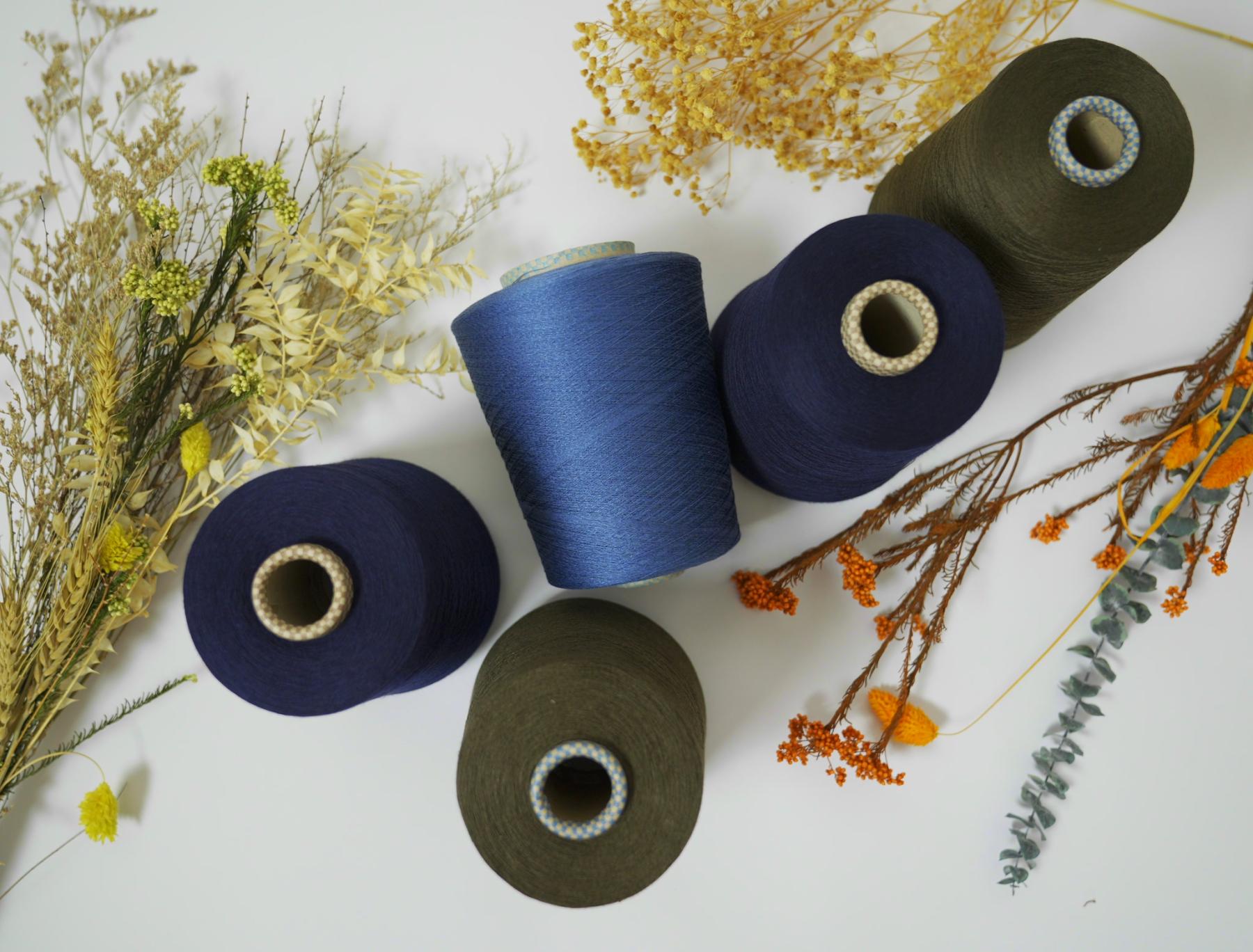
Fine yarn on a cone opens up far more possibilities than its first appearance suggests. A single strand can create an airy, delicate fabric, while two, three or more strands held together can produce anything from a light sweater fabric to a warm, substantial knit. You can also combine different fibres—such as merino with mohair or cashmere with silk—to change the colour, texture, warmth and drape.
The useful part is that you do not have to guess blindly. Metres per 100g give you a practical way to estimate the combined thickness, and a washed swatch confirms whether the yarn behaves as your project requires. This guide explains how to hold yarn double or triple, calculate the resulting length-to-weight ratio and plan enough yarn for the whole project.
What does holding yarn double mean?
Holding yarn double simply means knitting with two strands as though they were one. The strands can come from two separate cones, from the outside and centre of a wound cake, or from the same yarn divided into smaller cakes. The same principle applies when holding three, four or more strands together.
This technique is especially useful with fine deadstock cone yarn. Industrial yarns are often much finer than familiar hand-knitting yarns, but they are not limited to tiny needles. Combining strands lets you build the weight that suits your pattern while preserving the softness, colour and fibre character of the original yarn.
Why knit with multiple strands?
- Adjust the thickness: turn a fine yarn into a fuller working yarn without changing fibre or colour.
- Create a custom fabric: combine the elasticity of merino with the halo of mohair, or the warmth of cashmere with the drape of silk.
- Mix colours: closely related shades create depth, while contrasting strands produce a marled effect.
- Control density: use fewer strands for a translucent fabric or more strands for warmth and structure.
- Substitute yarn thoughtfully: build a combination that approaches the meterage and gauge of the yarn used in a pattern.
Holding strands together does not produce exactly the same fabric as one conventionally spun, thicker yarn. The strands remain separate and can create a softer, loftier or more dimensional surface. Treat the calculation as a starting point and the swatch as the final decision.
The simple calculation for identical strands
When all strands are the same yarn, divide the yarn’s metres per 100g by the number of strands held together:
Combined metres per 100g = original metres per 100g ÷ number of strands
For example, imagine a fine yarn with 1,400m per 100g:
| Strands held together | Approximate combined length |
|---|---|
| 1 strand | 1,400m per 100g |
| 2 strands | 700m per 100g |
| 3 strands | 467m per 100g |
| 4 strands | 350m per 100g |
This does not automatically assign the yarn a universal weight label. A smooth, tightly spun cashmere, a lofty merino and a brushed mohair can have similar metres per 100g but produce very different fabrics. Use the number to compare possibilities, then choose needle size from your washed swatch rather than from the calculation alone.
How to calculate two different yarns held together
When the strands have different lengths per 100g, do not simply average the two numbers. Each yarn contributes its own weight to every metre of knitting. A useful formula is:
Combined metres per 100g = 1 ÷ (1 ÷ yarn A metres per 100g + 1 ÷ yarn B metres per 100g)
Suppose you combine a merino measuring 400m per 100g with a fine mohair measuring 1,000m per 100g. The result is approximately 286m per 100g. That number helps you compare the combination with a pattern yarn, but the mohair’s halo may allow a larger needle and a more open gauge than a smooth yarn at the same length-to-weight ratio.
Combining fibres for different effects
Merino plus mohair
A strand of merino wool supplies elasticity and stitch structure, while mohair adds airy warmth and a luminous halo. Tonal colours make the base look richer; contrasting colours can create a soft, blended effect. Because the halo fills visual space, the fabric may appear fuller without becoming heavy.
Cashmere plus silk
Cashmere contributes lightweight warmth and softness, while silk adds strength, lustre and fluidity. The finished fabric may have more drape and less bounce than pure wool, so a generous hanging swatch is important for garments.
Several strands of the same yarn
Using identical strands gives the most predictable calculation and keeps the colour and fibre composition consistent. It is a practical way to use a very fine cone yarn for a sweater or accessory while adjusting the number of strands to suit the desired fabric.
Two colours held together
Two neighbouring shades create subtle depth that can read as a complex solid from a distance. High-contrast colours create a visible marled surface. Swatch enough fabric to see how the colours distribute: a combination that looks dramatic as loose strands can become surprisingly balanced when knitted.
How much yarn do you need?
When a pattern gives the required length of its original yarn, every working strand needs approximately that same length. If a sweater requires 1,200m and you plan to hold two strands together, you need about 1,200m of each strand—or 2,400m in total when both strands come from the same yarn.
For identical yarn, you can also multiply the original yarn weight by the strand count. If your swatch shows that four strands of a 1,400m-per-100g yarn work for the pattern, 1,200m of finished knitting consumes 4,800m of the fine yarn. At 1,400m per 100g, that is approximately 343g before adding an allowance.
Add extra for swatching, joins, finishing and small gauge differences. Deadstock lots are finite, so it is safer to calculate the entire project before ordering. Our guide to choosing deadstock cone yarn for a project covers fibre, quantity and project planning in more detail.
Always wash your swatch
Fine cone yarn can change considerably after washing. Spinning oils may make the yarn feel firmer or look flatter on the cone. Once washed, fibres can bloom, soften and settle together, changing the gauge and filling the spaces between stitches.
- Choose a likely strand combination and needle size.
- Knit a generous swatch and record every yarn, strand count and needle used.
- Measure the gauge before washing.
- Wash according to the most delicate fibre in the combination.
- Dry the swatch flat without stretching it.
- Measure again and assess drape, softness, halo, elasticity and stitch definition.
If the fabric is too open, try more strands or a smaller needle. If it is stiff and dense, try fewer strands or a larger needle. See How to Work With Deadstock Cone Yarn for more about Nm counts, spinning oils and washing.
Practical tips for managing multiple strands
- Place cones where each strand can feed freely without crossing the others.
- Keep even tension and check that every strand enters each stitch.
- If working from one cone, divide enough yarn into separate cakes before beginning.
- Carry a small strand sample and write the combination on your swatch label.
- When joining yarn, stagger the joins so several ends do not create one bulky point.
- Buy enough from the same deadstock lot before it sells out.
Frequently asked questions
Is holding yarn double the same as double knitting?
No. Holding yarn double means treating two strands as one working yarn. Double knitting is a separate technique used to create a two-layered, often reversible fabric.
Does holding yarn double make it twice as thick?
It doubles the amount of fibre used per metre, but the visible thickness and gauge do not follow a perfectly fixed rule. Fibre type, twist, halo, needle size and washing all influence the finished fabric.
Can I use two strands instead of the yarn named in a pattern?
Yes, if the combined yarn produces the pattern gauge and a suitable fabric after washing. Compare metres per 100g as a starting point, then swatch. Matching gauge alone is not enough if the fabric is too stiff, loose, heavy or unstable.
Can I hold yarn directly from cones?
Yes. Keep the cones upright and separated so the strands unwind smoothly. If you need several strands from one cone, first divide the yarn into separate cakes or smaller cones.
Build the yarn your project needs
Holding yarn double or triple turns fine cone yarn into a flexible material rather than a fixed yarn weight. Start with metres per 100g, choose fibres for the fabric you want and let a washed swatch guide the final strand count and needle size.
Learn more about the Italian yarn mills represented in our deadstock collection, or explore Pure Light Fiber’s changing collection of limited Italian deadstock yarn, including fine cashmere, merino, silk and mohair that can be used alone or combined into a unique fabric.